
Quercetin for Dogs: Evidence, Safety & Label Guide
Short answer: quercetin is a plant flavonoid found in foods such as apples, berries, onions, and leafy vegetables. It is commonly included in dog allergy supplements because laboratory and animal-model research has examined its effects on histamine release and inflammatory signaling. The nickname “nature’s antihistamine†is useful shorthand, but it does not mean quercetin works like a prescription or over-the-counter antihistamine, and canine clinical evidence for allergy relief remains limited.
For dog parents comparing supplements, the practical questions are not just “does it contain quercetin?†They are: how much is listed, what serving provides that amount, what else is in the formula, how long the jar lasts, and whether the product is being used for daily nutrition or in place of care the dog actually needs.
What is quercetin?
Quercetin belongs to a group of plant compounds called flavonoids. Plants make these compounds as part of their own protective systems, and people and animals consume them in many foods. In supplements, quercetin may appear by itself or as part of a multi-ingredient formula.
A small canine bioavailability study followed nine adult beagles given different quercetin forms. It confirmed that dogs absorb and metabolize quercetin, but it also found low absolute bioavailability and meaningful differences between forms. That matters because the word “quercetin†on a front label does not by itself prove how much reaches circulation or what result an individual dog will have.
Why is quercetin called “nature’s antihistamineâ€?
Histamine is one of several signaling molecules involved in allergic reactions. Quercetin has been studied in laboratory and preclinical models for effects on mast-cell activity, histamine release, immune signaling, and inflammatory pathways. A 2025 systematic review of preclinical allergy models reported effects across several allergy-related markers, but every included study used mice or rats—not pet dogs with naturally occurring seasonal allergies. The authors also noted substantial differences between studies and called for better clinical trials.
So the nickname is a description of the research interest around quercetin, not proof that a quercetin chew is interchangeable with veterinary allergy medication. For medication choices, use our separate allergy medicine for dogs guide and work with your veterinarian.
What the evidence does—and does not—show for dogs
The evidence backs three careful conclusions:
- Dogs can absorb quercetin. Canine pharmacokinetic research has measured quercetin and its metabolites after oral administration.
- Formulation matters. Different quercetin forms produced different absorption patterns in the beagle study.
- Direct canine allergy-outcome evidence is still limited. Preclinical mechanisms and laboratory findings are not the same as a controlled trial showing that a specific dog supplement reduces itching.
This is why a responsible product comparison should focus on transparent label amounts, a weight-based serving, the complete formula, and realistic claim language rather than guaranteeing a result.
How to compare quercetin supplements for dogs
1. Find the exact quercetin amount
Look for milligrams per serving, not merely “contains quercetin.†If the active amount is hidden inside a proprietary blend, you cannot make a useful comparison.
2. Match the amount to the serving directions
An amount listed “per two chews†is not the daily amount for every dog. Read the weight-based serving and calculate what the dog actually receives each day.
3. Read the entire formula
Quercetin supplements are often multi-ingredient products. Check every active and inactive ingredient, animal-derived source, flavor, and allergen that matters for your dog. A dog with a known food issue may need a different product even when the highlighted active sounds appropriate.
4. Separate daily nutrition from flare treatment
A daily supplement is not an emergency treatment for facial swelling, breathing difficulty, severe skin damage, infection, or uncontrollable itching. Those situations need veterinary care.
5. Compare days per jar and cost per day
Jar price alone can be misleading. Divide the chew count by the dog’s daily serving, then divide the price by the number of days. This makes two products with different jar sizes and serving rates easier to compare.
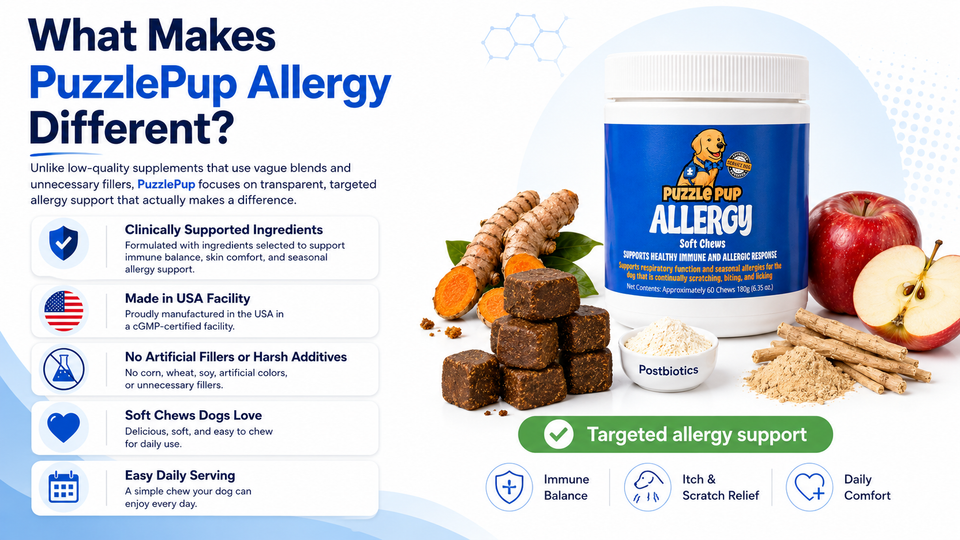
PuzzlePup label example: quercetin amount and daily serving
PuzzlePup Allergy Soft Chews list 75 mg of quercetin per two soft chews. That equals 37.5 mg per chew. The current label serving is one chew per 25 pounds of body weight daily:
| Dog weight | Label serving | Quercetin from that serving | Approx. jar duration |
|---|---|---|---|
| Under 25 lb | 1 chew | 37.5 mg | About 60 days |
| 25–50 lb | 1–2 chews | 37.5–75 mg | About 30–60 days |
| Over 50 lb | 2–3 chews | 75–112.5 mg | About 20–30 days |
Those numbers describe this product’s label; they are not a general standalone quercetin-dosing recommendation. The formula also lists postbiotic, arabinogalactan, ashwagandha root extract, bovine colostrum, turmeric root powder, pancrelipase, and two probiotic strains. The complete active and inactive ingredients remain available on the Allergy Soft Chews product page.
Safety and medication interactions
“Natural†does not mean interaction-free. Published research has documented that quercetin can affect drug metabolism in experimental settings, and safety reviews identify medication interactions as an area requiring care. Talk with your veterinarian before adding a concentrated quercetin product if your dog takes medication, has kidney or liver disease, has another diagnosed condition, is pregnant or nursing, or is already receiving multiple supplements.
Do not use a human gummy or flavored supplement without checking every ingredient. Human products may include sweeteners, combination ingredients, or doses that were not designed for dogs.
Where quercetin fits in a seasonal-allergy plan
Quercetin is one possible part of daily nutrition. Trigger reduction and skin care still matter. Wiping paws and the lower coat after walks, using baths appropriately, maintaining flea prevention, and tracking seasonal patterns can make the overall plan clearer. Our seasonal-allergy home plan covers those non-product steps.
If you are comparing complete formulas rather than researching one ingredient, use the seasonal allergy supplement guide. If you are unsure whether the visible pattern points toward Allergy or Skin & Coat nutrition, use the 60-second PuzzlePup match quiz.
Compare the complete formula—not one buzzword
See the exact label amounts, weight-based serving, jar duration, full ingredients, and the difference between Allergy and Skin & Coat.
Frequently asked questions
Is quercetin an antihistamine medication?
No. Quercetin is a plant flavonoid studied for several allergy-related mechanisms. “Nature’s antihistamine†is a nickname, not a statement that it is equivalent to an antihistamine drug.
How much quercetin is in PuzzlePup Allergy Soft Chews?
The current product label lists 75 mg per two soft chews, or 37.5 mg per chew. Daily serving is based on body weight.
How long should I try a daily allergy supplement?
Follow the product label and your veterinarian’s guidance. Track the same visible signs consistently rather than changing several parts of the plan at once. Severe symptoms, open skin, infection, or worsening discomfort should not wait on a supplement trial.
Can quercetin replace Apoquel, Cytopoint, or another veterinary treatment?
No. Do not stop or replace prescribed treatment without your veterinarian. Supplements and medications have different roles, evidence, onset, and safety considerations.
Can dogs get quercetin from food?
Quercetin occurs naturally in several plants, but food content is variable and feeding a food is not the same as using a measured supplement. Avoid assuming that more of a quercetin-containing food is automatically better or appropriate for a dog.