
How Long Do Dog Supplements Take to Work?

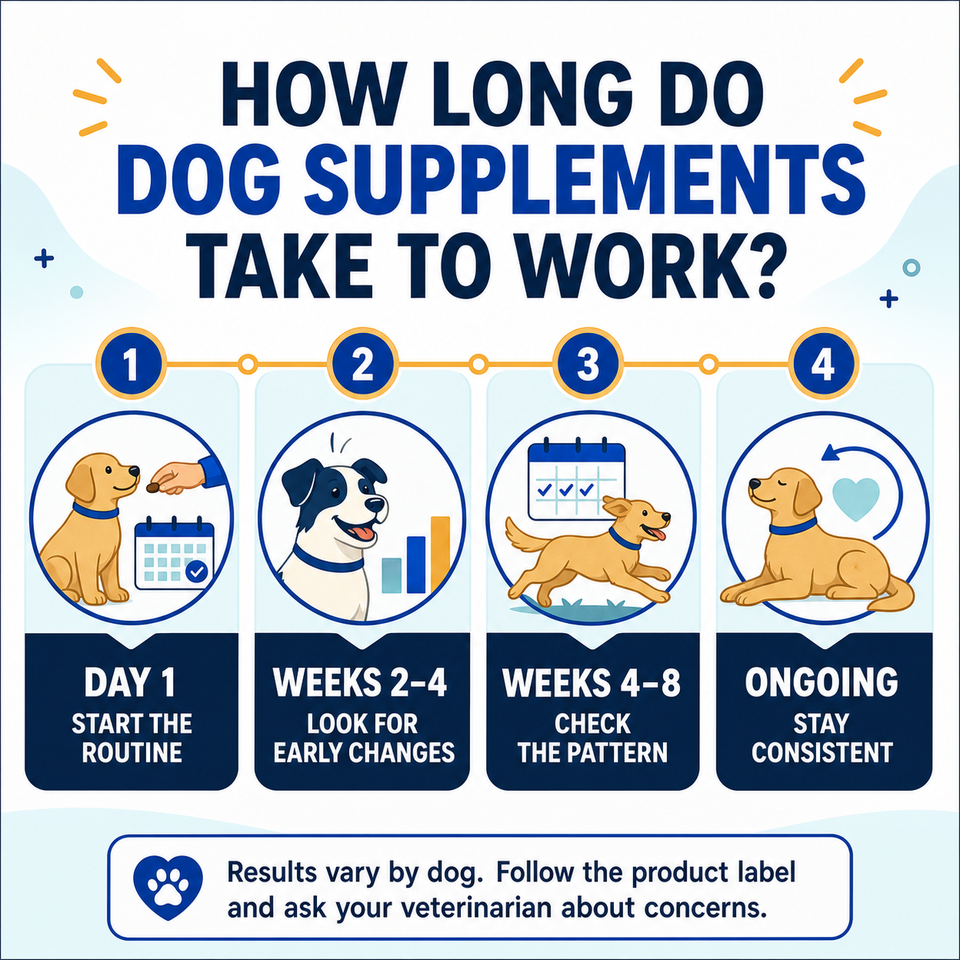
Short answer: Most dog supplements need 4 to 8 weeks of consistent daily use before you can fairly judge whether they're helping. Skin and coat changes often show up first — frequently around the 4-to-6-week mark, because that's roughly how long it takes for a new, healthier coat to grow in. Mobility formula usually takes longer, commonly 6 to 8 weeks or more, since it works gradually rather than like a painkiller. Seasonal-allergy ingredients work best when you start it before the season ramps up rather than in the middle of a flare. The single biggest reason people think a supplement "didn't work" is that they stopped at week two. Supplements strengthen your dog's normal, healthy function over time — they don't treat, cure, or prevent disease, and anything that promises an overnight fix is worth a second look.
When our founder started Normie, our service dog, on his first supplement, the hardest part wasn't picking one. It was the waiting — and not knowing what "working" was supposed to look like. Here's the honest version we wish we'd had.
Why Supplements Take Weeks, Not Days
A supplement isn't a drug. A prescription anti-itch medication is designed to interrupt a specific pathway quickly — that's why it can work in a day. A supplement works differently: it supplies nutrients and compounds your dog's body then uses at its own pace, through processes that simply take time.
That timeline isn't a marketing excuse. It's biology:
- Coat quality depends on hair that's actively growing. You can't improve the hair that's already grown out — you're waiting on the new growth to come in, and that takes weeks.
- Joint and mobility formula works with slow-turnover tissue. Cartilage and joint fluid don't refresh overnight.
- Anything routed through the gut — including postbiotic and gut-focused ingredients — depends on a gradual shift, not a switch being flipped.
So the realistic question isn't "how fast does this work?" It's "am I willing to give this a fair, consistent trial?" Daily consistency matters more than dose-chasing. A chew given four days a week isn't a real trial.
A Realistic Timeline by Supplement Type
Every dog is different, and these are general patterns rather than promises. But they'll keep your expectations honest:
Skin & Coat: often 4–6 weeks
This is usually the most visible category, because you can literally see the result. Owners often notice coat texture and shine first, with shedding and flaking changes following. Omega-3s, biotin, and zinc — the core of our Skin & Coat Soft Chews — strengthen the skin barrier and normal coat growth, so the payoff arrives on the coat's schedule, not yours. If you want the deeper explainer, we broke omega-3s down in Omega-3 for Dogs.
Hip & Joint: often 6–8 weeks or longer
Joint formulas are the category people quit too early. Glucosamine, chondroitin, MSM, and boswellia maintain normal joint comfort and mobility gradually. Because there's no dramatic day-one moment, the change is easiest to see when you've written down what your dog was like at the start. Our Hip & Joint Chews are built for that daily, long-game use.
Seasonal-allergy formula: timing beats speed
This one is less about a countdown and more about when you start. Ingredients like quercetin, turmeric, postbiotics, and ashwagandha — what's in our Allergy Soft Chews — are best begun a few weeks ahead of your dog's usual problem season, so the ingredients are already in daily use when pollen counts climb. Starting mid-flare is still worth doing, but it's a harder ask.
Digestive changes: days to weeks
Fiber can change stool quality within days because it acts mechanically in the gut rather than waiting on tissue turnover.
How to Actually Tell If It's Working
Here's the trap: change this gradual is nearly invisible when you live with your dog every day. You will not notice a 20% improvement day over day. You'll only notice it against a record.
So before you start, spend five minutes doing this:
- Take photos. Coat, any problem patches, and your dog standing normally. Same spot, same light, once a week.
- Write down 2–3 specific things — not "seems itchy," but "scratches during evening TV," "hesitates at the back steps," "licks left paw after walks."
- Note the start date and commit to a real trial window: 8 weeks.
- Change one thing at a time. If you start a supplement, a new food, and a new shampoo the same week, you'll never know what did what.
- Re-read your notes at week 8 — don't rely on memory. Memory is exactly what fails here.
That last step is the whole game. Most owners who say "I couldn't tell" never wrote down a starting point.
Not sure which category your dog actually falls into? Our quick allergy quiz walks through what you're seeing and what tends to help — it takes about a minute.
When It's Not the Supplement
A fair trial also means being honest about the ceiling. A supplement maintains normal function — it isn't a fix for an underlying medical problem, and it shouldn't be asked to be.
Talk to your vet — sooner rather than at week eight — if your dog has:
- Sudden or severe symptoms, or symptoms that are clearly getting worse
- Signs of pain, limping that's worsening, or reluctance to move
- Broken skin, hot spots, an odor, or a suspected infection
- Ear problems, which often need direct treatment rather than supplements
- Any symptom that's new and unexplained
None of that is a supplement's job. If something's genuinely wrong, the faster answer is a vet visit, and a good supplement fits around that plan — not instead of it. Your vet can also flag interactions with medications your dog is already on, which matters more than most labels admit.
The Honest Bottom Line
Give it 8 weeks. Give it daily. Write down where you started. If you've done those three things and genuinely see nothing, that's real information — and it's a much better reason to switch than a vague feeling at week two.
That's how we run it with Normie, and it's why we'd rather set a realistic expectation than sell you a miracle.
Frequently Asked Questions
How long does it take for dog supplements to start working?
Most take 4 to 8 weeks of consistent daily use before you can fairly judge them. Skin and coat changes are often noticeable around 4 to 6 weeks, while mobility changes commonly take 6 to 8 weeks or more. Results vary by dog, and consistency matters more than anything else.
Why isn't my dog's supplement working?
The most common reasons are not enough time, inconsistent dosing, or no baseline to compare against. Give it a full 8 weeks daily, and write down specific starting symptoms so you can measure change. If symptoms are severe or worsening, see your vet — a supplement maintains normal function and isn't a treatment for an underlying condition.
Can I give my dog more than one supplement at a time?
Often yes, but check with your vet first, especially if your dog takes medication or the products share ingredients. It's also worth starting one at a time so you can tell what's actually helping.
Do I need to give supplements every day?
Yes — daily consistency is what makes the trial meaningful. Occasional dosing doesn't give the ingredients a fair chance, and it's the most common reason owners can't tell whether something worked.
When should I start an allergy supplement for my dog?
Ideally a few weeks before your dog's usual problem season begins, so the ingredients are already in daily use before symptoms ramp up. Starting during a flare is still worthwhile, but earlier tends to be easier on your dog.
This article is for general information and isn't a substitute for veterinary advice. Always consult your vet about your dog's specific health needs.