
Glucosamine, MSM & Boswellia for Dogs — What Each One Actually Does

If your dog is slowing on stairs, stiff in the mornings, or hesitating before the jump into the car, you've probably started reading joint-supplement labels — and hitting a wall of ingredient names. Here's the plain-English version of what the big ones actually do.
Glucosamine
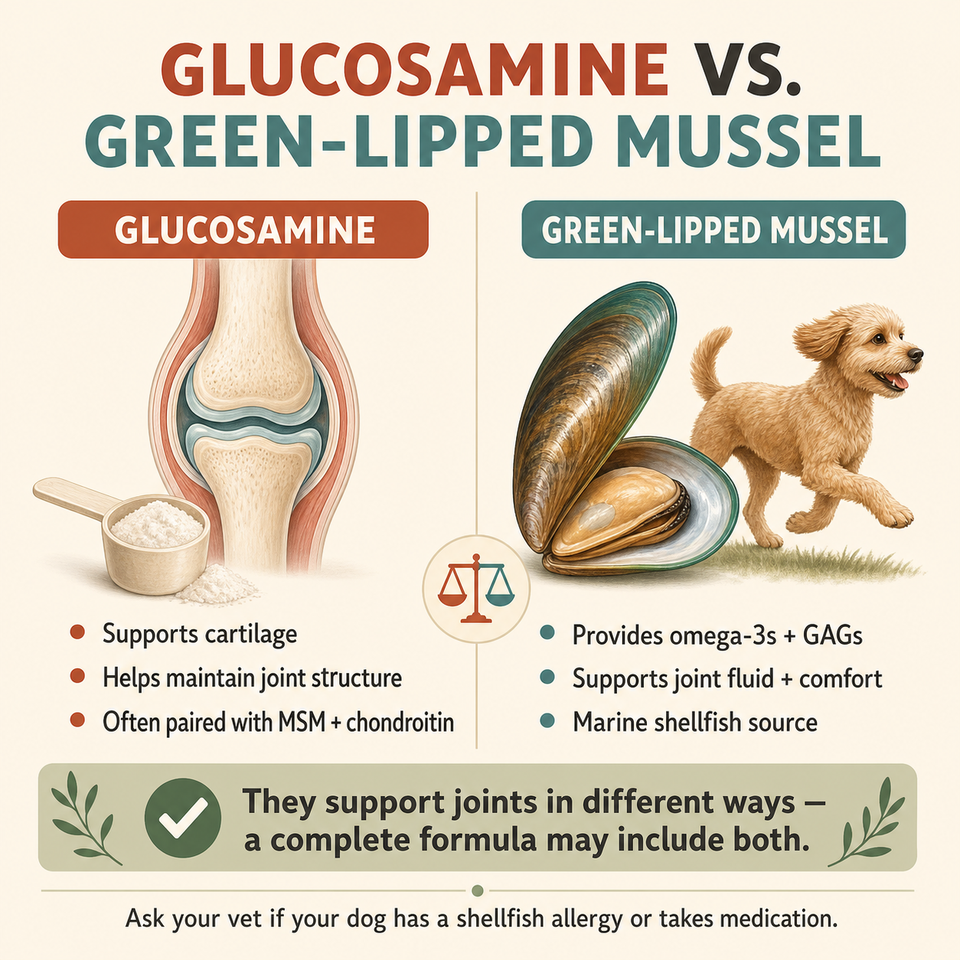
A building block of cartilage. Glucosamine strengthens the cushioning that keeps joints moving comfortably, and it's the most studied mobility ingredient for dogs.
Chondroitin
Usually paired with glucosamine. It helps cartilage stay resilient and hold onto water, and maintains healthy joint lubrication.
MSM
A natural source of sulfur the body uses for connective tissue. Owners often add it for everyday stiffness and comfort.
Boswellia
A botanical (boswellia serrata) traditionally used to keep joints comfortable and mobile — a plant-based complement to the others.
Green-lipped mussel
A marine ingredient that naturally supplies omega-3 fatty acids and glycosaminoglycans (GAGs). It is used in some joint formulas to maintain normal joint fluid, mobility, and everyday comfort. Because it comes from shellfish, check with your vet if your dog has a known shellfish sensitivity or takes medication.
How to read a joint-supplement label
- Look for amounts, not just an ingredient list. A useful label tells you how much each active ingredient is supplied per serving.
- Check the serving by weight. Compare the amount your dog actually receives, not only the amount in one chew.
- Watch for overlapping products. If you stack supplements, shared ingredients can add up.
- Give it consistently. Mobility ingredients are intended for daily use over time, not occasional rescue dosing.
Write down one or two baseline behaviors—such as morning stiffness, stair hesitation, or willingness to jump into the car—then compare again after a consistent trial. That is more reliable than trying to remember a gradual change.
What to realistically expect
Joint ingredients do not flip a switch. These ingredients work gradually — most owners notice easier movement within 3–6 weeks of daily use. The goal is steady, long-term comfort and mobility, not an overnight fix. Our Hip & Joint Soft Chews combine all four in one daily chew, sized by weight.
🎁 Get 15% off your first order
Not sure if it's their joints? Take our free 60-second quiz for a tailored pick — and unlock 15% off.
Take the Hip & Joint Quiz →When to talk to your vet
If your dog is in obvious pain, suddenly limping, or declining fast, see your vet — joint supplements maintain healthy joints but aren't a treatment for injury or advanced arthritis.
Questions dog parents ask us
How long until my dog moves easier?
Most owners notice a difference within 3–6 weeks of daily use.
Is this safe for older or large dogs?
Yes — it's formulated for daily use and is a favorite for seniors and big breeds. Dose by weight.
What if it doesn't help?
You're covered by our 30-day money-back guarantee.
Built for my service dog, Normie. Perfected for yours. — Mike & Normie